|
|
|
Four great seasonal festivals celebrated by all Tibetan Buddhists are: Losar, Saga Dawa, Chokor Duchen and Lhabab Duchen. During those times, it is believed that the effects of positive or negative actions are multiplied ten million times. Tibetan Calendars The Tibetan type of calendar is similar to other ancient ones in that it requires periodic adjusting. This type of system produces some doubled months and occasional missed days. Therefore it can happen that the first month is doubled as was the case in 2003. Then the New Year celebration may be held in the second First Month. When does a day begin? We need to know, so we can observe anniversaries and holidays on the appropriate day. Consider Western observances. Sometimes we say the day starts right after midnight, but sometimes it is when the light of morning appears. For some, an observance begins at dusk when a dark and a light thread can no longer be distinguished. For others, when the first star appears. Tibetans consider that the day begins at first light. The moment is determined by the ability to see the lines on the palm of your hand. Of course this tradition is only useful in places that have not been polluted by ambient light from artificial sources. The introduction of the traditional calendar system dates to the enthronement (127 BCE) of legendary ruler, Nyatri Tsenpo, the first of the Chogyals (Dharma Kings.) The Tibetan way of tracking the years is similar but not identical to that of the Chinese system of 12-year cycles. Five elements: wood, metal [or iron], air, fire, and water rotate among 12 animal signs to produce 60-year units. The animals are of the two sexes, so that makes each distinctive era consist of one full round of 120 years. A round is called in Tibetan, rabjung; we are in the 17th rabjung, according to the predominant tradition. The most prevalent Tibetan calendar is based on an astrological treatise called The Oral Teachings of Pundarika (Tib. pad- dkar zhal-lung) by Phukpa Lhundrub Gyatso (fl. 1447.) This is the basis for the Phukluk astrological tradition used by the majority of Tibetans and currently regarded as the official Tibetan calendar. Another tradition known as the Tsurluk derives from the revised astrology of the Third Karmapa Rangjung Dorje (1284-1339) as found in his Compendium of Astrology (Tib. rtsis-kun bsdus-pa.) The Tsurluk tradition is used by Dr. Tendhar at Nitartha. In 2006, some Kagyupas (such as KTD) celebrated Losar at the end of January but others, such as the Jamgon Kongtrul labrang in Pullahari, Nepal, and members of Kagyu Samye Ling in Scotland observed it with the Gelugpas and the majority of the Tibetan exile community, in the second of a double first month which was at the end of February. LosarLosar is the Tibetan New Year. It is determined by the conjunction of the lunar calendar with the solar cycle. It falls at New Moon preceding the spring equinox, usually in February. In Ladakh, the New Year is earlier, celebrated on the first day of the eleventh month. There are three types of Losar observance: Religious ceremonies, such as the one performed by the Kagyu denomination that follows the calendrical revision established by the 3rd Karmapa (see Dzogchen Ponlop Rinpoche's nithartha.org ) However since the events of 1959, most Tibetans no longer celebrate "religious" losar but only the "Royal" or King's Losar. In 2014 it corresponded with Chinese New Year at beginning of March. There are also regional Farmers' Losar that depend upon agricultural events such as the blooming of a local fruit tree, etc. Losar is said, by sources in Dharamsala, to have originated as a farmers' festival in the pre-Buddhist period
when, in the Lhokha Yarla Shampo
region, the first signs of blossom appeared on the apricot trees. Families sprout barley seeds and place them before the family shrine on New Year's Day as a prayer for an abundant harvest. A p'ye-mar, or bucket is vertically divided in halves by a wooden slat, and filled with tsampa (roasted barley flour with butter) and barley seeds or the auspicious five grains, and decorated with stalks of barley and coloured butter. On the preceding evening, stacks of special bread, such as
kyapse, and other festive
food and is placed on the household shrine. Delicacies like
khu-khu, gachen, nayashok, mokdung, nagarlen, pin-pin and chang (Tibetan
beer) are some of the holiday fare. The final day of this 15-day period is known as Chötrul Düchen. On that day, it is said that the consequences of one's positive and/or negative actions increase 100,000,000 times. Therefore many people devote that day to prayer. Losar EmotionAccording to Khenpo Lobsang Jamyang of Sera May, in the Mongolian tradition people cry tears mourning the end of a year of life, but Tibetans are joyful in anticipation of new life. They greet each other with "Losar Tashi Delek" and observe the offering ritual of sangsol in which barley flour is thrown into the air to symbolize prosperity.
Some say that "sheep's head" and "the beginning of a year" sound the same, and
the sheep has traditionally been regarded as an auspicious animal in Tibet.
In a herder's home, a real (boiled, then roasted) sheep's head is on display. Others
make a representation of one out of colored
butter or use a replica made of ceramic or wood (more
about this below.) Nowadays, since people have to work the festivities may be postponed until the closest weekend after the 'official' date. Regional Festivities Extracts from Jan. 30, 2004, China Daily: "Tibetans Warm Up for Celebrations" Saga DawaThe Buddhist anniversary and spring festival usually coincides with Vesak (Vaisakha) or Wesak as it is called in Indian languages. In Tibetan it is called Saga Dawa [Buddha's Moon]. It combines Buddha Shakyamuni's birth [Skt.: purnima] on the 7th day of the 4th month with three other events: On the 15th day of the same month he is believed to have entered his mother's womb, and on that day decades later, he attained complete enlightenment at dawn. Then, a lifetime later, he passed into parinirvana at dusk on that same day of the year.
In some communities, the image of the Buddha is bathed and special offerings are made, and often there is a procession of Buddhist scriptures. In India, monastics may make a pilgrimage to Lumbini or another holy spot. Chokor DeuchenThis is a summer celebration on the 4th day of the 6th month. It commemorates the Buddha's First Turning of the Wheel, that first sermon concerning the Four Truths. Tradition has it that Buddha was not convinced by his own reflection that teaching what he had discovered during his own meditation -- that is, the Truth of Suffering and the 3 other Noble Truths -- would be of any benefit to others. It took the intercession of the great gods, Brahma and Indra, to persuade him to do so for the benefit of all sentient beings. The Buddha then addressed the five people who had been his companions during the time he had spent with the forest yogins. The benefit of any virtuous action, including the recitation of mantras, is believed to increase 10 million times when performed on this anniversary. Lha-bab DeuchenLha-bab Deuchen [Tib.] is the
autumn festival that commemorates the
descent from the Trayastrimsha Heaven of Buddha Shakyamuni.
He had agreed to descend on the 15th of the 9th month, but actually descended on
the 22nd. The Circumstances When he was in his 41st year, the Buddha participated in a great debate at Shravasti, and defeated all opponents by manifesting miracles. Immediately -- some say to avoid being offered gifts and being treated as a god -- he vanished. He reappeared in the realm of the 33 gods, where he gave teachings to a company of celestial beings that included his mother. One of his Great Disciples, Anuruddha, could see him there and reassured the others. After three months, Maudgalyayana, another of the Great Disciples, begged the Buddha to return to earth. He agreed he would return in a week's time, so on the 7th day, Indra and Brahma constructed 3 ladders of lapis lazuli (or "beryl"/sapphire,) gold and crystal. The triple staircase reached from the summit of Mount Meru to Samkashya. At the appointed time, He descended the central flight of steps with Indra and Brahma on either side to be received by crowds gathered at its base. Legend has it that the triple staircase used by Buddha, Brahma and Indra slowly faded away, until only the part enclosed by Emperor Ashoka's temple remained. As time passed, even that disappeared so that only the subterranean structure was left. Now it, too, has vanished.
Mon-lamThis is a two-week prayer festival beginning at Lhosar that was initiated by the founder of the Gelugpas, Tsongkhapa, in 1409 CE in Lhasa, Tibet. The different denominations may have a Monlam at different times (in 2003, the Kagyu Monlam began at the end of December.) Nowadays people of all denominations often gather to celebrate and practice together. Since 1959, these gatherings have taken place in various Buddhist centers including Lumbini but Bodhgaya, the site of Buddha's enlightenment, is the most important.
The Yearly Round of Tibetan Holidays
~ Michael Erlewine's complete, comprehensive calendar by Heart Center Publications is available at Namse Bangdzo. It includes a teaching by Khenpo Karthar and has tide tables, too. __________________________________________________________________________ Xigaze Prefecture: The political reality since the 1950's is that, besides the Tibet Autonomous Region (which can hardly be considered "autonomous,") large portions of Tibet have been absorbed by China.
|
|
|

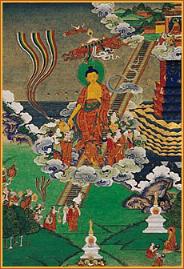 He had vowed to repay
his mother in gratitude for all that she had done for him, and so he spent three
months in Tushita teaching her and other gods and goddesses in order that they, too,
might be released from the pitiable state of samsara -- the otherwise
eternal round of birth, life, and death.
He had vowed to repay
his mother in gratitude for all that she had done for him, and so he spent three
months in Tushita teaching her and other gods and goddesses in order that they, too,
might be released from the pitiable state of samsara -- the otherwise
eternal round of birth, life, and death.