|
His Holiness
Urgyen Trinley Dorje the 17th Gyalwang Karmapa
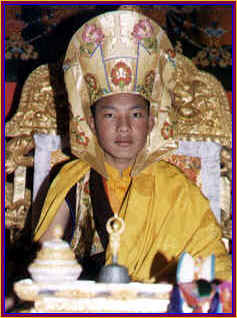

Who is The Karmapa? A brief montage of film
prepared for Karmapa's May 2014 visit to Europe here\/
https://www.youtube.com/watch?v=po7OKrxn0ww#t=200 Tibetan
rapper Dawa Tsona sings praises to the 17th
Gyalwang Karmapa at
https://www.youtube.com/watch?v=pEZf2csZSaM
::
Kagyu
Office USA ::
http://kagyuoffice.org.tw/ :: http://kagyuoffice-fr.org/
:: View
16th &
17th Karmapas (Chinese & English text.)
:: May-June 2008 Historic 1st American
visit :: Jul 29/11:
YouTube video
of Karmapa at the Kaye Theater (Hunter College, NYC. Lama Yeshe
Gyamtso translating) If you have
no time to watch all 81 minutes right now, try
starting at minute 54.

Pal Khyabdak Rangjung
Ogyen Gyalway Nyugu Dodul Tinley Dorje Tsal Chokey Nampar Gyalway De
His name means Glorious Pervasive Spontaneously Manifest [Guru of] Udyana, Scion of Victors, Vajra of Enlightened Teaching Activity, Accomplished One
Victorious in Every Direction.
All Karmapas are considered the continuity of one
active compassionate essence. As such, we can invoke him through the
mantra, Karmapa Khyenno.
The boy's parents told those who came to make inquiries about the circumstances of his birth that their son often rode off alone on jackals and goats into the mountains. As a toddler, "He built toy monasteries and a throne of stone and earth, where he would sit and recite prayers." Also, "When others were killing animals, he would look at them with great compassion and shed tears." ~
K. Holmes. Karmapa.
He was recognized in 1992 and on 13 June 1992 he went to Lhasa where he performed his first "official" religious duty on June 27 (BBC). That same year he was enthroned in a ceremony on 27 September at the seat of the Karmapas, Tsurphu Monastery. Chinese officials were there to present ceremonial scarves. Though he was not yet eight years old, 20, 000 people attended the September 29,
1992 Chenrezig Empowerment that was his first public teaching.
In 1994, he
was also invited to Beijing.
His first recognition of a tulku was of the Pawo Rinpoche, in 1995.
Later, at Tsurphu, historical seat of the Gyalwang Karmapas in
Central Tibet, he gave many teachings and
empowerments, holding audiences and blessing thousands of people everyday. Then,
he was to make a momentous decision.
He arrived in India in January 2000 after a perilous journey, in order to be able to continue to benefit as many as possible.
The powerful impression he made was captured by a reporter at The Independant, UK, who
described him as "a tall, muscular, moon-faced young man in maroon robes, with a shadow of stubble on his shaven scalp and one eye a little larger than the other - as someone put it, one was for looking at the outside world and the other for looking in."
In 2001, he was given immigrant status by the Indian government, and went on pilgrimage to the holy shrines of Buddhism and to Ladakh. Although
he was not yet 16 years old, Karmapa's Monlam teachings at Bodhgaya were called remarkable by the monks and
other devotees who attended, including those of other sects.
The 17th Gyalwa Karmapa was ordained as a novice monk (dGe
ts'hul p'ha) in 2002. He had already taken on full
responsibility as leader of the Kagyu denomination by October 2002, when he
requested Kagyu monasteries take steps to see that the special traditions of Marpa
be carefully preserved through regular practice.
Karmapa has been tutored by the most accomplished teachers of the
Kagyu including Khenchen Thrangu Rinpoche, Khenpo Tsultrim, the late Tenga Rinpoche and
the late Bokar Rinpoche. He is also close to HH the 14th Dalai Lama of the Gelugpa
order.
At Rumtek, Sikkim, Indian seat of the Karmapas:
"The afternoon prayer to Mahakal and Mahakali, accompanied by the staccato sound of the gong, sonorously rolls out like it’s done for decades. The devotees swing their folded hands up in the ancient ritual, then fall to the ground. The
dalda flame flickers on, in front of the compassionate Buddha. Only
Ugyen Thinley Dorji stares back impassively, the unblinking eyes of his photo-portrait waiting for the arrival of the real thing.
"
~ Jyoti Malhotra Indian
Express Oct. 24, 2002.
In Jan. 2004, he again taught thousands of people (Buddhist,
Hindu, Muslim and others) at the seat of the Buddha's Achievement in Bodhgaya, Bihar,
India.
In May 2008, he visited the USA -- his first visit outside
India, and he has since returned
In July 2013 he turns 28, according to the Western
way of calculating age, but he
is still in temporary residence at Ramoche.
- June 24/09,
Asia Times
Online Interview by Saransh Sehgal.
Karmapa: Hope of the future?
Feb. 23/05,
Times of Tibet, "Interview with His
Holiness the 17th Karmapa Ogyen Trinley Dorjee" by Tsering Dhundup [who
lives in Toronto]:
Tsering Dhondup: It is said that at the time of
your birth numerous auspicious signs were witnessed in your village. Do you remember your past life and the circumstance of your birth?
H.H. Karmapa: Frankly speaking, I do not remember
anything about my birth; I am
a normal child like any other. What has or has not happened were beyond my
decision. Yes, my parents and relatives told me that there were numerous
auspicious signs -- signs like the sound of conch shell being blown, which
occurred during the time of my birth, was similar to that witnessed when the
5th and 13th Karmapa were born.
Tsering Dhondup: How do you compare your life here
in India to that back in Tibet?
H. H. the Karmapa: Tibet is my country and I feel
that I was happy living there; but I do not feel any unhappiness living in
India.
Tsering Dhondup: What in your view is the essence
of Buddhism?
H. H. the Karmapa: In my view, the essence of
Buddhism consists in reducing physical, mental and verbal defilement. We
should not harm other beings even if we cannot help them. It is important to
develop love, kindness and sincere motivation. It is very important to
practice these Bodhisattva qualities and contemplate on the essence of
Bodhichitta.
Tsering Dhondup: How can one manage negative emotions like
attachment, fear hatred, pride, etc?
H. H. the Karmapa: Lord Buddha has shown that
there are limitless methods to tackle one's problems. We must understand these
methods. The important qualities are contemplation on the loving kindness,
compassion, emptiness and meditation and practice them in our daily life. We
must sincerely dedicate these qualities for the benefit of other sentient
beings. It is also very important to have a genuine master to guide one in the
right way.
Tsering Dhondup: The human society is beset with
numerous problems, or rather, conflicts. How do you think they could be best
addressed?
H. H. the Karmapa: There are many problems in our
society and all these occur due to selfish motives. Important tools to resolve
conflicts can be developing compassion to other beings, developing sincere
motivation and putting effort to bring unity and harmony. It is
important to think others as more important than oneself.
Tsering Dhondup: How can we make our life more
meaningful by applying the concepts of Buddhist philosophy?
H. H. the Karmapa: Our body, speech and mind are
laced with defilement due to which we find ourselves subject to various kinds
of suffering. We must strive for happiness by training our mind. If we manage
to train our mind, we can bring peace, happiness, harmony and joy for all
sentient beings. The problem is that we are not practically achieving them
because we fail to train our mind. Buddhism is a very strong tool for taming
the mind and bringing it to a peaceful state. So, if we can train our mind, we
can definitely achieve peace and happiness, which is the ultimate aim of our
life.
Tsering Dhondup: How do you compare modern life to the ancient?
H. H. the Karmapa: The only difference that I find
between ancient and modern life is the development of modern scientific
technology. With the development of science and technology, there are fast
communication between nations and individuals. But despite the absence of
these, I feel that our ancient ancestors had more joy and happiness. People in
the past were more peaceful, more motivated, more patriotic, and there was
more love among the people. I respect the ancient people because they were
very genuine and sincere in nature and understanding. And ancient culture is
richer.
Tsering Dhondup: Do you have any special advice for our readers?
H. H. the Karmapa: I have not much things to say
now, yet I believe that it is very important to build one's life in a very
meaningful way. Thinking about making one's own life as well as dedicating
work for the goodness of other beings is equally important. The modern life is
more busy and tougher, so it is important to strive to build sincere
intention, motivation and indulge in positive and pure actions. As a Tibetan,
we should not waste our time. We must do our own work as well as we must think
about our nation to bring more unity and harmony among ourselves as well as
with other people. Development of positive wishes is also very valuable.
Source: Tibetan Review.
- Jan.2005, a European contributor just back from India wrote:
| . . . the Kagyu Monlam 2004 under the
guidance of His Holiness was an overwhelming experience for me. His Holiness
is really a Buddha. I saw him so many times from further away and also from
very near. Although I understood only half of the translations because my
English is not perfect at all and I do not read nor write Tibetan, . . .
I could not follow the pujas, -- it was all beyond words. I did not expect
this before. During the teachings for "international" students in the
evening . . . I felt that H.H. was trying to establish a very personal
kind of contact to the audience who had come to see him from so very far
away.
He told us about his first experience of Emptiness, and he spoke about
his flight over the Himalayas and that it is not easy for him to know that
many people have to suffer because of h[is] having become a political
subject and that sometimes he thinks that he is doing more harm than good.
It was very emotional and moving sometimes; also for the monks at the
door.
I had the impression that H.H. enjoyed the monlams and the
teachings in the evening. He was relaxed, and everybody was listening so
tensely. On Christmas His Holiness [sang] a song for us -- as a
present.
He did not want us to make prostrations before him ([but] under the Bodhi
tree we made prostrations together with him in the direction of the tree)
and in the evening teachings he sat on a chair, not on a throne, and he
poured his hot water from the thermos himself; there was no servant to
do this, and he also switched the recorder on and off himself.
He is a normal young man, and yet he is not. He is very clear and direct
and immediately comes to the point without frills.
[ . . . .]
Now I am back home and it feels like I had been in a dream in a Pure
Land. I am still an alien in my daily life.
~ R. R.
|
-
Mar 2/09 Issue of NEWSWEEK,
"Tibetan people. Tradition may need to change." by Patrick Symmes :
(Khandro.Net editorial remarks indicated
by numbers in square brackets [ ] Corresponding comments follow this
article.)
For a god,[1] he is a nice young man. Lean and assured, dressed in
red and gold, the Karmapa Lama is a scholar-prince greeted with bows
wherever he treads. He switches between Chinese and Tibetan fluently,
studies Korean at night and occasionally interrupts a translator to voice
polite outrage in English. In his temporary quarters, at a new
monastery outside Bodh Gaya in eastern India, he can be glimpsed at dusk,
between courtly duties, pacing slowly on a lofty terrace that overlooks
women gathering wheat from the parched fields below.
The Karmapa, now a handsome 24-year-old with a shaved head, was born to
a family of nomads in 1985. But then a party of monks, told to search
"east of snow" for their new leader, found him in eastern Tibet. At the
age of 7, he was enthroned as a living deity, the 17th reincarnation in a
succession of Buddhist leaders of the Kagyu sect. At 14, he fled his
native land in a dramatic escape over snowy passes to Nepal, and then
India, where he attached himself [2] to the exiled Tibetan leader, the
Dalai
Lama. Tibetans in the diaspora immediately saw something special in the
Karmapa Lama—the deep personal charisma of his mentor, infused with the
vigor of youth. Some saw, even then, a potential leader in his own right.
The Dalai Lama is without peer among living Tibetan deities.[1] As head of
Tibet's biggest sect, the Gelug, he is the revered and recognized leader
of his people. He has won the Nobel Prize and built a global following on
little more than moral strength, somehow keeping a movement of rival sects
[3] and international pressure groups united behind the notion of justice
for Tibet. Yet the Dalai Lama has failed in one key respect: China
has rejected even his mildest calls for autonomy and cultural freedom.
March will mark 50 years since the Dalai Lama slipped into exile.
Some Tibetans now believe that the Karmapa Lama may be able to succeed
where the Dalai Lama has failed—if, against all tradition and precedent
[4], he is given an opportunity to lead.
But a change of power among the Tibetans, as among less mystical
movements, is a tricky business. Now 73, the Dalai Lama has shaken off
minor illnesses, yet muses openly on his death or incapacity, urging
Tibetan exiles to plan what may come after. By tradition, the 14th Dalai
Lama will essentially hand off power to himself, when he is reincarnated
after death. In one of the more intriguing rituals of Tibetan Buddhism,
a search committee of monks interprets augury, dreams and mystical symbols
on remote lakes, and then dashes off on horseback to identify and enthrone
a baby as the next Dalai Lama. The problem is that it takes about 20 years
before a credibly educated, suitably adult figure emerges to stand up for
his people. And no political movement in this day and age—particularly one
that China is determined to strangle—can survive a 20-year pause.
"The Chinese hard-liner strategy has always been, when the present Dalai
Lama passes away, the Tibetan movement will fizzle out, or
disintegrate," says Lobsang Sangay, a senior fellow at Harvard Law
School who participated in a recent conference on the future of the
Tibetan exiles in Dharamsala, the exile capital in western India. "So
the issue is, is there anyone who can replace him? What will happen to
the Tibetan movement after he passes away? That's the big question."
Lobsang is one of those who argues that the question already has a
perfect answer: the Karmapa Lama can serve as a temporary replacement.
Because he comes from a different sect, he can't become the Dalai Lama,
but he could serve as regent until a new reincarnation reaches
adulthood. The Karmapa is suited for this, in part, because he embodies
the story of his people—a story of oppression, escape and exile that is
very similar to that of the Dalai Lama himself, who fled Lhasa disguised
as a common soldier in 1959. The Karmapa fled in 1999, at a time when he
was under Chinese pressure to denounce the Dalai Lama. Instead, he
joined the exile leader—after a daring late-December trek over the
Himalaya. Some 150,000 Tibetans out of 6 million have made similar
journeys to exile.
In recent years, the younger monk has been increasingly seen under the
Dalai Lama's wing. The two live near each other in Dharamsala. Foreign
delegations seeking audience with the Dalai Lama often find the Karmapa
Lama included, or are urged by the Dalai Lama himself to seek out the
newcomer. "He has grown up to be a very attractive lama to the general
public," Lobsang says, "but also, importantly, to the young. They can
connect with him. He's of the same age. They know the hardships he went
through to escape."
At the meeting of Tibetan exiles in November, at least five of 15
working groups listed the Karmapa as a suitable candidate to lead the
community in the future. He was mentioned by the prime minister of the
Tibetan government-in-exile as a potential leader, and also by the Dalai
Lama, who named him among several monks who might emerge to lead the
movement. In one scenario, the Dalai Lama would appoint the Karmapa now,
to serve after the senior monk's death as a formal regent, [5] providing
theological and temporal leadership until a new Dalai Lama comes of age.
By naming a young and popular regent now, the Dalai Lama could assure a
smooth transition to a figure who has become like a son to him, while
dashing Chinese hopes of simply outwaiting the Tibetan exiles. He might
also help to head off a full-blown power struggle over succession. As it
is, any new leader—or joint leadership—will have to balance sectarian
rivalries, win over alienated youth in Dharamsala, mollify the demands
of sympathizers abroad and possibly deal with rival claimants to the
title of the next Dalai Lama (each with his own powerful tutors and
advisers).
The Karmapa Lama is not the only possible choice to forestall a
succession struggle. The Dalai Lama has spoken highly of other monks,
including the reincarnation of his former teacher. In a theological
twist, the Dalai Lama also ruled last year that he can, under a doctrine
called madey tulku, select his own reincarnation while still alive
(dualism of this kind—alive, yet already reincarnated—rarely bothers
Tibetans). This would allow the Dalai Lama to shorten the period without
a leader, and control the selection and education of his replacement.
But Chinese officials immediately disputed the ruling, insisting they
alone have the historic right to choose the Dalai Lama's successor. This
means that two rival Dalai Lamas would likely emerge, clouding the issue
of succession for decades. Here the Karmapa offers another potential
solution: he is the only major tulku, or reincarnation, currently
recognized by both the Chinese and the Dalai Lama. He could be the hinge
on which relations between Tibetans and China swing in a new direction.
The Karmapa's monastic order holds a prayer festival every January in
Bihar, India's poorest province, at the spot where Buddha is believed to
have attained enlightenment in the sixth century B.C. Called Monlam,
the
prayer festival had about 200 attendees in 1993. But several years ago,
when the Karmapa Lama began to appear himself, the crowds swelled, and
now 10,000 monks, nuns and lay people attend. They mostly want to hear
the teachings of the Karmapa—regarded as the living manifestation of the
four-armed goddess of compassion—accompanied by deep-voiced, ritualistic
Tibetan chants and trumpets. This year the grounds of the pilgrimage
site sometimes resembled a Buddhist Woodstock, with juniper smoke and an
aroma of yak-butter candles blowing over the massed ranks of monastic
adepts in saffron- and wine-colored robes.
Among several thousand lay people present, Tibetan exiles—women in
striped aprons, and men in off-the-shoulder-jackets—barely outnumbered
those speaking in the accents of Boston, Birmingham and Berlin. Although
it is rarely acknowledged, foreign followers translate into power.
Donations from Asia and the West help build new monasteries, wealthy
supplicants fill begging bowls with silk and cell phones, and lamas who
can shuttle between Boulder and Bihar assume greater importance than
those who cannot. The temptations of the material world are not unknown
even here: at the Monlam festival, the Karmapa sacked the administrator
of a monastic center in Gangtok for corruption. A sweating and visibly
nervous replacement was led out of a meeting with the Karmapa as a
reporter from NEWSWEEK was brought in to an interview.
The rituals of Tibetan Buddhism approximate those of a medieval court,
with hushed attendants, servants lighting incense and fetching tea, and
hundreds of petitioners waiting for a word with the "glorious teacher of
the karma people." Still, the Karmapa observes the probities of monastic
life, fasting and sitting for long hours of meditation. His own interest
in comfort seems no greater than massaging his toes at the end of a long
day. "A little tired," he explained in his tentative English to a
NEWSWEEK reporter who interviewed him twice during five days spent
following him around. Visitors normally present white scarves to high
Tibetan lamas, but the Karmapa seemed to make little of the offerings,
and playfully drew an extra scarf [6] from a pile of luxurious silks to
toss
at the reporter. Most questions from journalists were "too easy," he
warned through a translator.
After that flash of pride, the Karmapa directed attention away from
himself—as befits one who has renounced the ego. Asked directly if he
can replace the Dalai Lama as a leader, he replied that he was only one
of many possible heirs. "The Dalai Lama is like the sun. No matter how
many stars there are, they don't look too bright in comparison." A
broader leadership could form, he suggested, "if many stars come
together [with] the same strength and power and brilliance of that sun."
The Karmapa shares the Dalai Lama's ability to navigate modern questions
of geopolitics with a delicate balance of aphorism, riddle and ancient
verities about compassion, nonviolence and generosity—along with modern
nostrums on global warming and overconsumption. He has condemned
violence, including the Tibetan riots against Chinese rule in Lhasa last
April that killed dozens of ethnic Chinese. But he says he understands
the "sheer frustration, the sheer sense of suffocation" of Tibetans
scattered in exile or forced to live under Chinese rule. "For any living
being," he said, "when you feel the force of being cornered time and
again, more and more, the time comes when you have nothing else left
except to explode."
The risks of explosion were increasing, he said, and every day that the
Chinese stalled in accommodating legitimate Tibetan demands merely
increased the chance of chaos. "The Chinese Communist Party needs to
understand that for right now, there is His Holiness the Dalai Lama.
[He] is the main force that is controlling the emotions, keeping the
wave of anger from spilling out. When there isn't somebody like him,
then there is a great danger." But isn't there someone like him waiting
in the wings—the Karmapa Lama, perhaps? "I have no goals, nor any
ambitions to be of great influence," the Karmapa said during the
interview at his monastery in Bihar. "But if circumstances make me a
force for change, then I am a force for change."
In some obvious ways, the Karmapa Lama is a wrong choice to replace the
Dalai Lama. Already a tulku, or reincarnation, he cannot be chosen as
the reborn Dalai Lama. The Karmapa is also from a rival school of
Buddhism, the Kagyu, a small order known colloquially as the Black Hats.
Naming the Karmapa as regent would effectively place an outsider at the
head of the Dalai Lama's own Gelug, or Yellow Hat, sect. That's like
sending an Episcopalian to oversee the Vatican for 20 years.
But the choice of the Karmapa is so wrong, it may be right. If the Dalai
Lama acts decisively now to name the Karmapa as regent, or appoints him
to lead in a purely temporal capacity, the choice could unite Tibetans
more than divide them. "Theological issues are becoming secondary,"
Lobsang of Harvard notes. Choosing the Karmapa Lama fits "the political
reality of the Tibetan movement."
"He's young," says Lhadon Tethong, the executive director of Students
for a Free Tibet, which has 30,000 members worldwide. "Everyone talks
about this. He's clearly a strong, dynamic character in Tibetan life,
not just religious life, but spiritual and political life. He represents
a new generation that continues to defy Chinese efforts to control
Tibetans."
Asked during a second interview if he was in communication with the
Chinese, the Karmapa at first demurred and deflected. He spoke instead
of an enlightened Chinese policy toward Tibet, one that would be based
on demonstrating China's Great Power status and accommodating Tibetan
desires for genuine autonomy along the lines proposed by the Dalai Lama.
The Karmapa then rose to leave, before being called to a halt by a
reminder that the question was about contacts with China.
"I have no contacts, nothing political with anybody," he said—and then
shrewdly conceded that some form of contact had taken place. The Chinese
had conveyed, via India, that the Karmapa Lama should not engage in any
political activities, he said. Yet if he remains purely a spiritual
leader, China will not close a door on him.
"That's perfectly fine. I don't even know what politics is," the
24-year-old monk said with a broad smile. It was impossible to know for
sure, but the smile could have been signaling just the opposite.
[1] Karmapa is not a god. Neither
is he a deity in the usual sense of the word. Due to the lack of subtlety in the
vocabulary of many languages used for public media, and/or the limitations of
translation, misleading expressions like "god king" have become widespread.
[2] "Attach himself" : At
that time, like many other Tibetan refugees, Karmapa at first paid his respects
to the Dalai Lama, who had helped Tibetans establish communities in India. The
Dalai Lama kindly offered Karmapa the use of residential quarters in a small
temple that belongs to the monastic denomination to which the DL belongs.
[3] Himalayan Buddhist
sects or denominations are not "rivals." They have different histories,
with their distinctions deriving from mutually respected interpretations of
fundamental texts. It is also true, though, that in past centuries, one or
another of the denominations has risen to a position of prominence due the
vagaries of politics and the favour of a ruler or other kinds of personal
influence.
[4] See [3] -- at times,
and in various areas of historical Tibet, the prominent role was played by the
Karmapa, or a leader of the Sakya or the Nyingma denominations.
[5] This "scenario" truly would
be a revolutionary one. See [3] . A high lama of one denomination, with its own
distinctive view and specialized training, would not likely be acceptable as a
"regent" for another denomination.
[6] "extra scarf" : These scarves
are not considered to have intrinsic, material or personal value. They are
like flower garlands. Also, anything once offered to someone, is his or hers to
dispose of. The significance of the tossing of such a kata (Tibetan for this
kind of scarf ) is that it is a blessing -- freely given.
Some Memorable Milestones
Original message by the late Michael A. Doran of KTD,
sent Wed., Jan. 05/00 at 4:29 PM concerning His Holiness Karmapa's flight from Tibet:
We always believed that First Light 2000 would be an inspiration to all the world, and it was. What we could not have known was that His Holiness Karmapa would choose that time of practice and prayers to flee Tibet. His Holiness is now finally free!
His Eminence Tai Situ Rinpoche called today to confirm that His Holiness Karmapa, Ugyen Trinley Dorje arrived safely in Dharamsala, India on January 5, at 10:30 in the morning Dharamsala time. He is currently with His Holiness the Dalai Lama and His Eminence Tai Situ Rinpoche.
His Holiness Karmapa left Tolung Tsurphu Monastery on December 28th with a handful of attendants. The flight from Tibet took seven days on foot. From Dharamsala, His Holiness is likely to spend some time at Sherabling, His Eminence Tai Situ Rinpoche's monastery, before journeying to Rumtek.
Karmapa Chenno! [<
the mantra
is used here to express praise.]
 Music in the Sky: The Life, Art & Teachings of
the 17th Karmapa Ogyen Trinley Dorje by Michele Martin (USA: Snow Lion
Publications, 2003) is a 400-page paperback
with 59 color, 12 b/w photos, 8 maps & drawings. US $18.95
A stirring account of adventure that incl. Karmapa's first teachings, poetry and calligraphy. Music in the Sky: The Life, Art & Teachings of
the 17th Karmapa Ogyen Trinley Dorje by Michele Martin (USA: Snow Lion
Publications, 2003) is a 400-page paperback
with 59 color, 12 b/w photos, 8 maps & drawings. US $18.95
A stirring account of adventure that incl. Karmapa's first teachings, poetry and calligraphy.
____________________________________________________________
Note: The Sakya Trizin, the Gyalwa Karmapa, and the Dalai Lama are all called His Holiness,
as are some Nyingma leaders. However this designation, instituted by some
well-intentioned people when these masters first became known outside Tibet, and
as it does not conform to the traditional role of great Buddhist lineage
leaders, we among others are gradually abandoning it because it is
misleading.
calculating age: In
2010,
Westerners
celebrated his 25th birthday but east Asians count it as his 26th.
Ramoche: Gyuto Ramoche Tantric University,
Sidbhari, Kangra District, Himachal Pradesh, India. It was offered as a
temporary residence by the Dalai Lama.
Ugyen Thinley Dorji:
There are many ways of rendering Tibetan names into European languages such as
English. Urgyen can be Ugyen, Ogyen, Orgyen, Odjen, etc.
Trinley can be Trinlay, Thinley, Tinlay, etc. since the r
is not pronounced. Dorje can be Dorjee, Dorji, Dordge
and so on. Also, the word Karmapa transliterated using the
Pinyin Chinese system is Garmaba, and the rest of his name is rendered O'kying Chilai Doje.
[ Back ] [ Home ] [ Up ]
[ Karmapa ]
[ From the State of Peace ] [ Qualities ] [ Vajra Guru Mantra Project ] [ 1st Journey to the West, 2008 ]
|
